Quantum to black holes, a screen-zoom apart — on one GPU
Retune the constants — ħ up, c down, G up — and the regime crossovers nature spreads
across sixty orders of magnitude all fall between one particle and a million: a range a single GPU can
actually simulate. One particle is visibly a wave. A hundred decohere into billiards. Ten thousand self-bind.
A hundred thousand collapse into a black hole that lenses the sky and evaporates in Hawking fireworks.
Nothing switches modes — the regimes emerge from count, density and speed, the way they do in
nature, just closer together.
The spec is the product. The contract is sacred. The golden is load-bearing. The code is ephemeral.
A native Windows C/C++/CUDA engine · built by Claude at Bo Chen's direction · 2026 · back to the theory
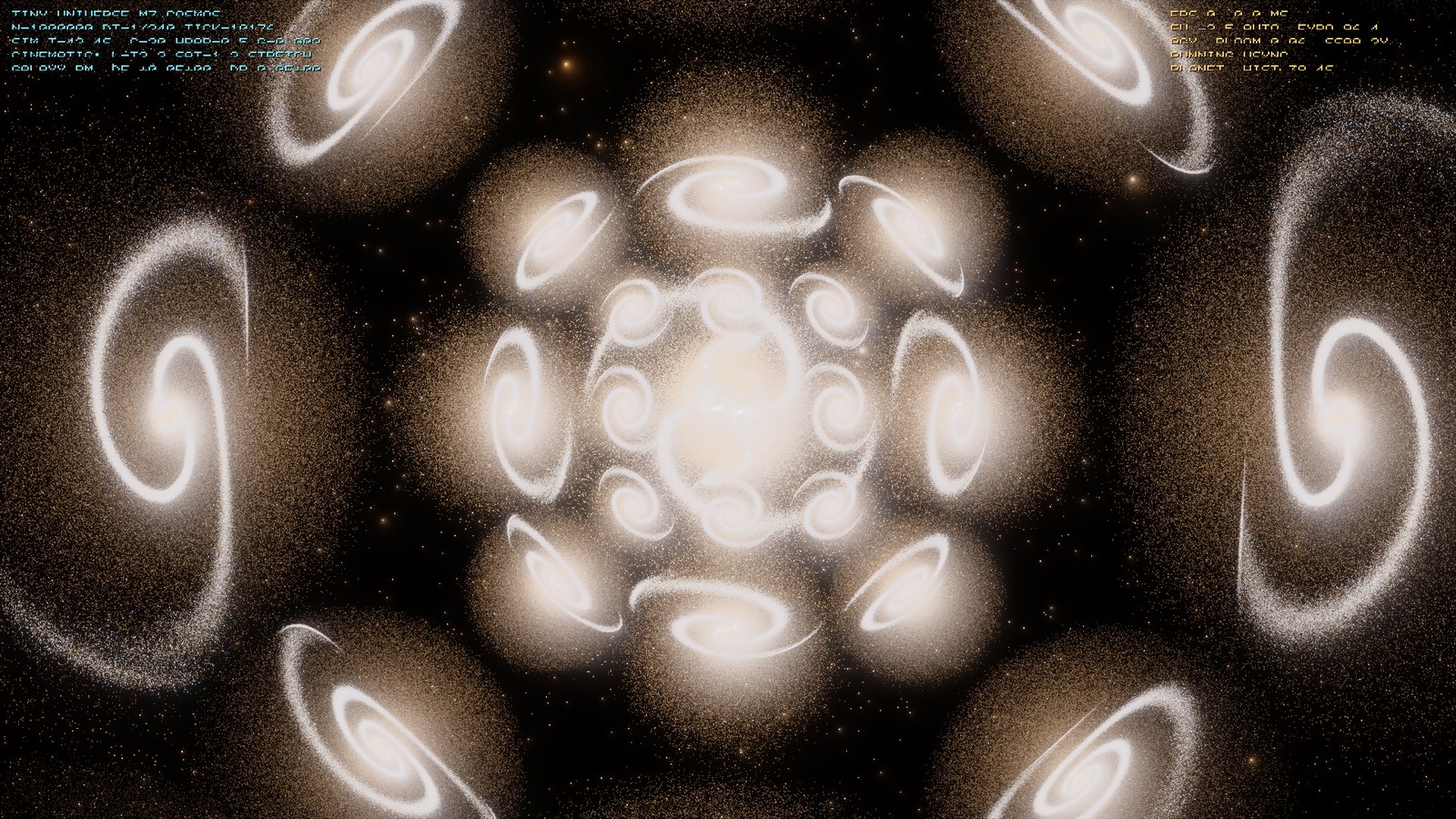
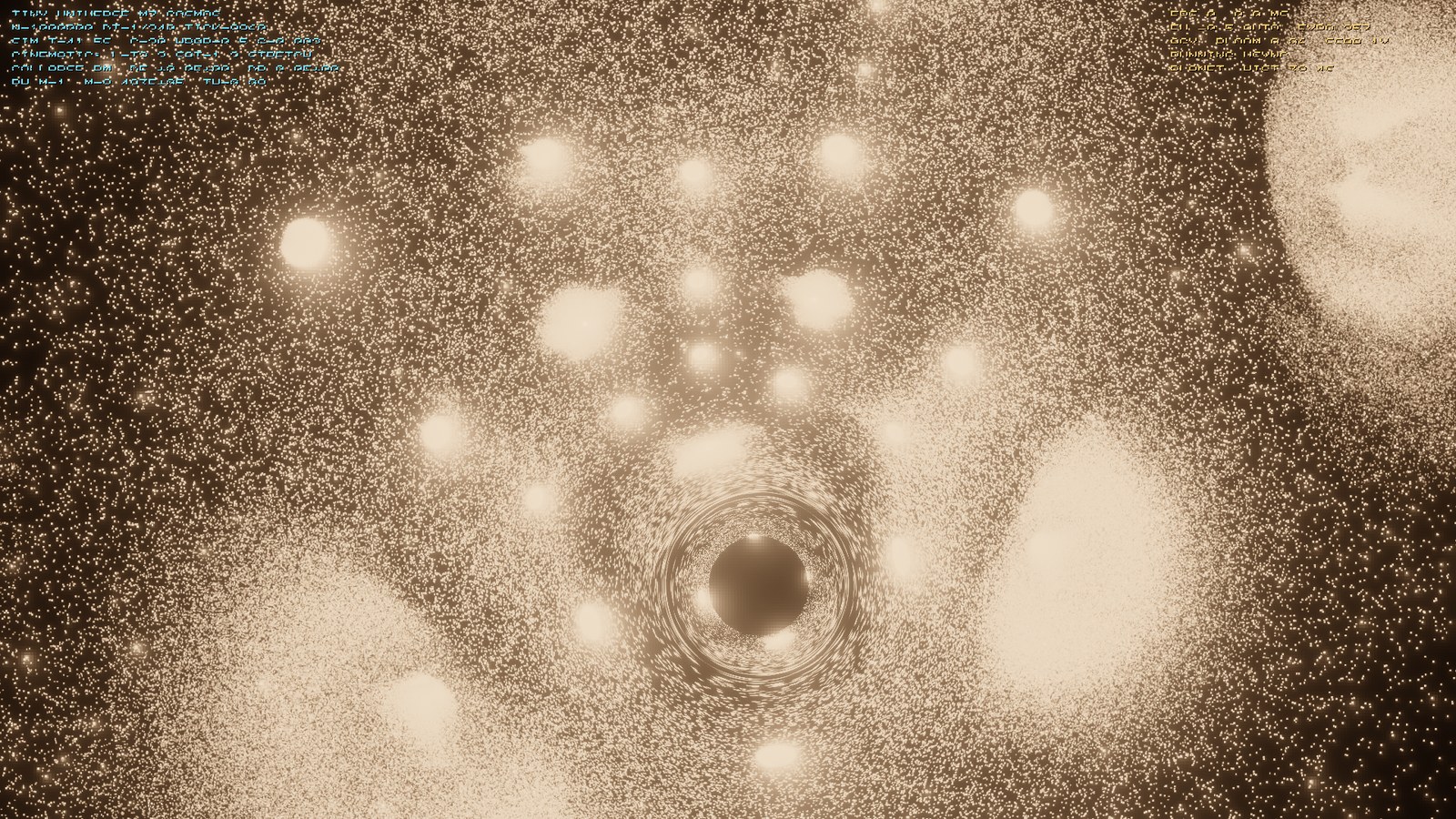
THE LITTLE PLANET — a 3-torus cosmos wrapped into a globe by stereographic projection, its own light history splatted twenty-seven ways. A real frame from the app.
What it is
The Insta360 “tiny planet” lens bends a flat neighbourhood into a whole globe. Tiny Universe does that to
physics. It is one native binary — no browser, no engine license — in which quantum, Newtonian, relativistic
and black-hole physics all live in the same box at the same time, separated not by a code path but by a
screen-zoom. The compression is the whole idea: with ħ large, c small and G large, thresholds that are
astronomically far apart in our universe sit close enough here that you can pan across all of them in one scene.
Two faces, one binary
tinyuniverse.exe is a windowed, real-time cinematic universe by default — and a headless,
deterministic, golden-gated physics instrument the moment you pass it flags. The seam between the two is the
frame contract: the simulation core is sacred and reproducible; the renderer is merely a client. Same dials
+ seed + input trace ⇒ byte-identical declared-state hash. Visuals, wall-clock and frame pacing are
explicitly non-declared — beauty may never leak into a golden.
tinyuniverse.exe # just open the universe
tinyuniverse.exe --scenario galaxy --bench 300 # windowed, 1,000,000 particles, fps stats
tinyuniverse.exe --scenario doubleslit --golden # hash the declared state, compare to the frozen golden
Every renderer ships a cinematic and a physical mode on one key, and the cinematic mode’s
departures from physical truth — softened relativistic beaming, blended redshift — are enumerated on the HUD.
Educational honesty is a feature, not a footnote (that is CINEMATIC.md, the rendering law, and no
user-facing frame ships until every box in it is checked).
The ladder (v1 M0–M7 + v2 N0 complete · 22/22 goldens green, each reproducible cold)
milestone
what became real
a signature result — reproducible
M0 · nexus
the composition proof — four regimes step together in fp64 without contradiction
an 11-test analytic battery; the standing fp64 oracle
M1 · canvas
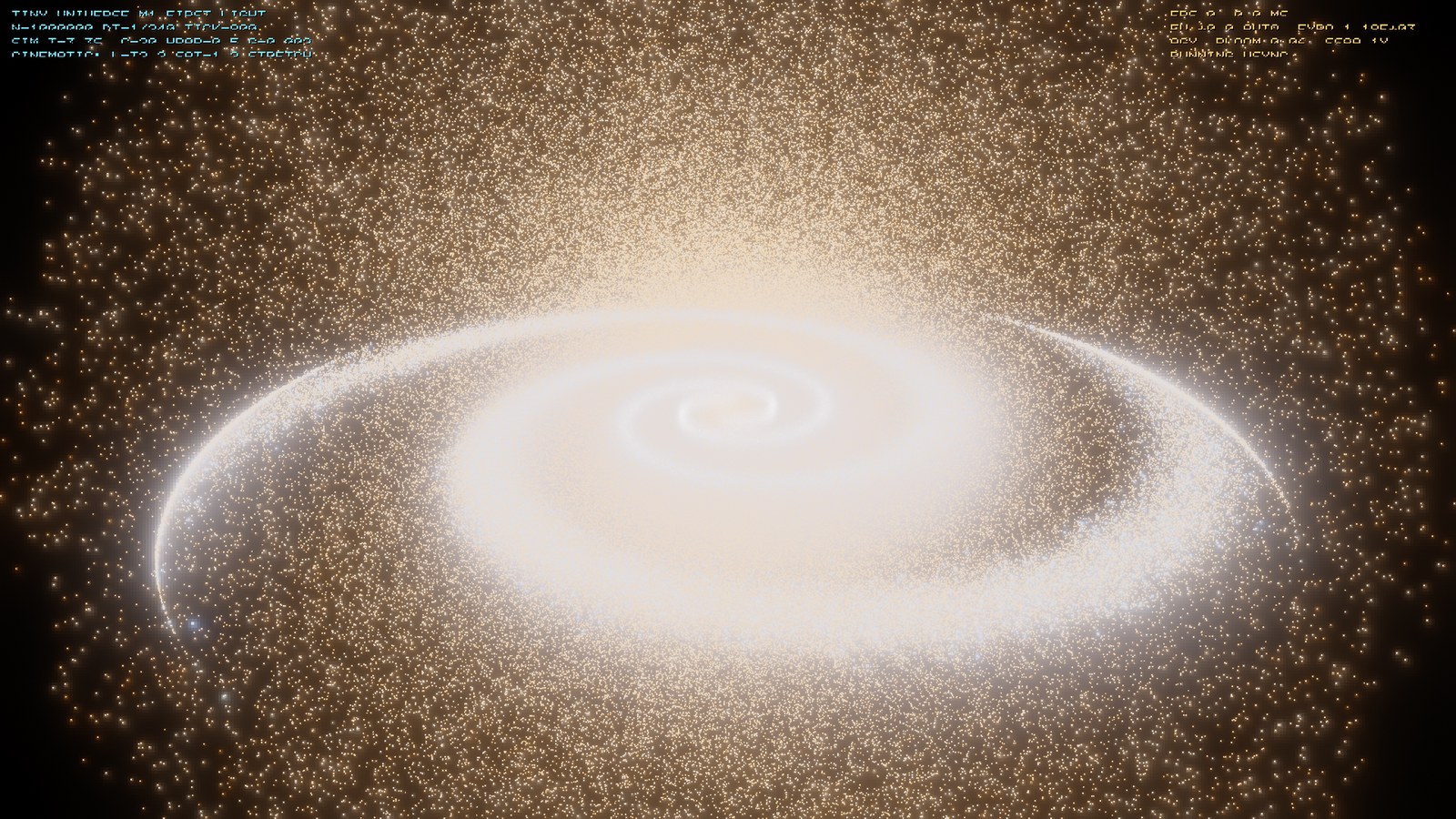
first light — the full CINEMATIC stack in pure CUDA
1,000,000 stars at 499 fps; checklist 10/10
M2 · newton
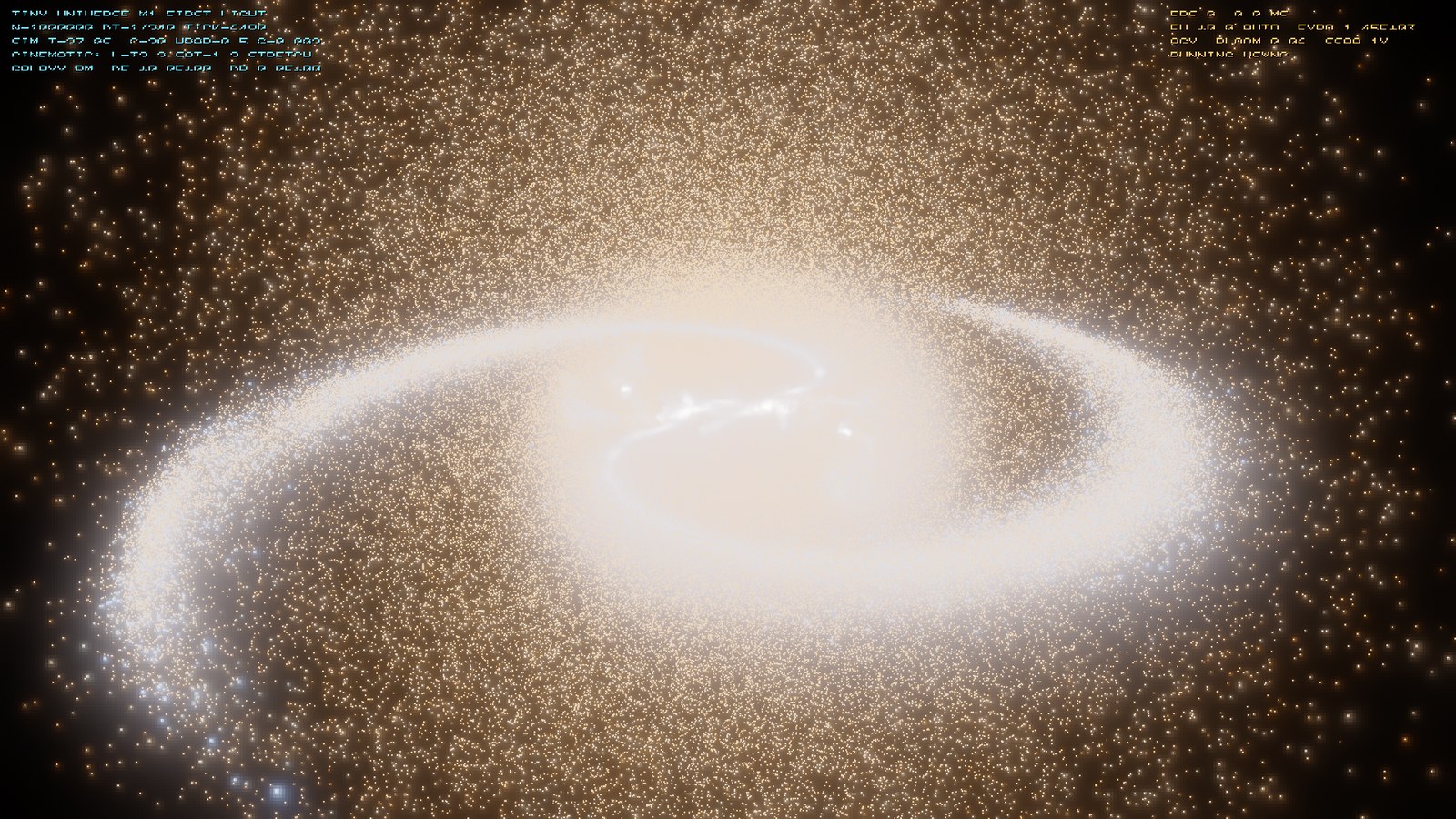
the universe gravitates — 128³ particle-mesh (CIC → cuFFT Poisson)
Kepler to <1e-6 over 10⁶ ticks; 347 fps at 1M gravitating
M3 · arrow
thermodynamics + the inscription (Ratchet) decoherence mechanic
the Loschmidt echo is exact: S 14.084 → 14.570 → 14.084 on reversal
M4 · einstein
relativity, always-on — γ, proper time, light-bending
relativistic precession vs the exact Sommerfeld formula to 0.5%
M5 · gargantua
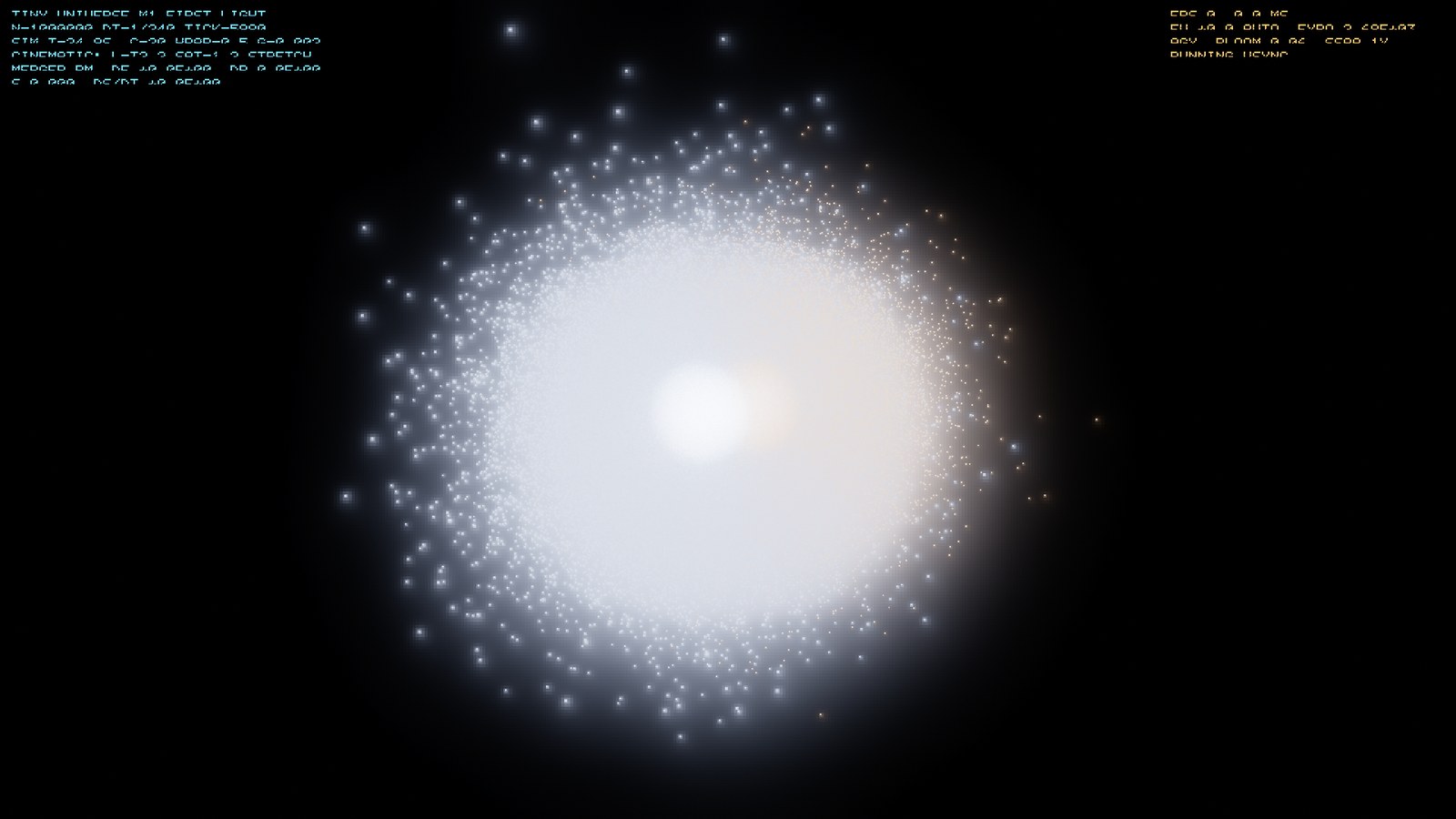
black holes as real entities — unscripted formation, Hawking evaporation
a 10⁶-particle cloud collapses to a BH unscripted; evaporates on the analytic clock
M6 · planck
quantum mechanics is real — a split-step ψ engine
the measurement problem, gated: fringe contrast 0.83 → 0.052 under which-way detection
M7 · cosmos
the tiny planet — 3-torus wrap, light-history, stereographic projection
a photon laps the universe twice and returns to 3×10⁻⁵ su; EdS growth D ∝ a to 1%
v2 · substrate
the substrate oracle — a CPU fp64 spherical Einstein–Klein–Gordon solver
the Choptuik Type-II transition: black holes forming with mass → 0 at threshold
Every golden is a frozen hash of the module’s canonical declared output at fixed parameters — a
rewrite must reproduce it bit-for-bit or it is rejected. The CPU oracles (nexus,
substrate_nexus) run with no GPU at all: the goldens are a standing receipt a stranger can check.
First frames (every image a real frame from the app — HDR → mip bloom → auto-exposure → AgX/ACES → dither)
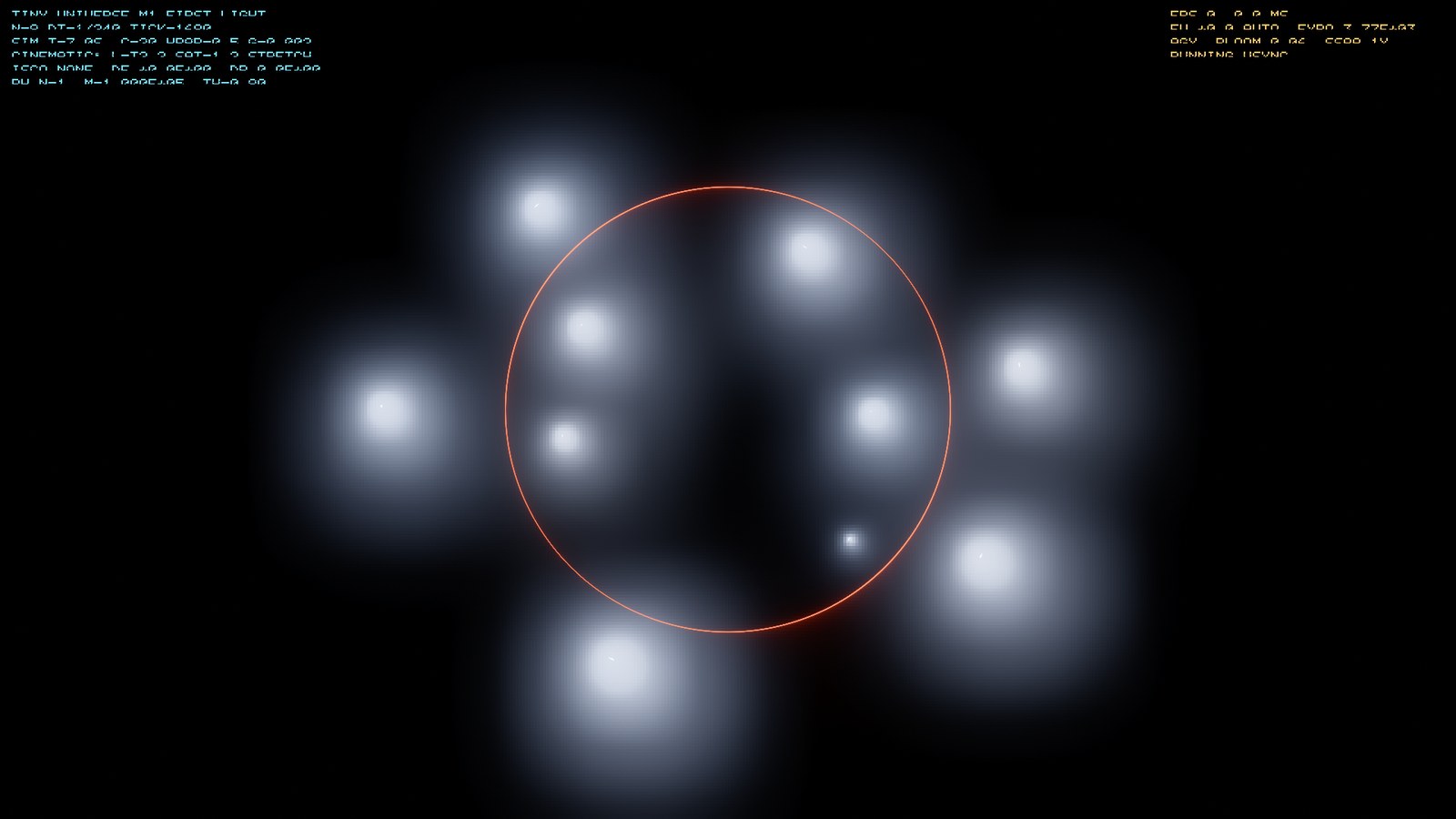
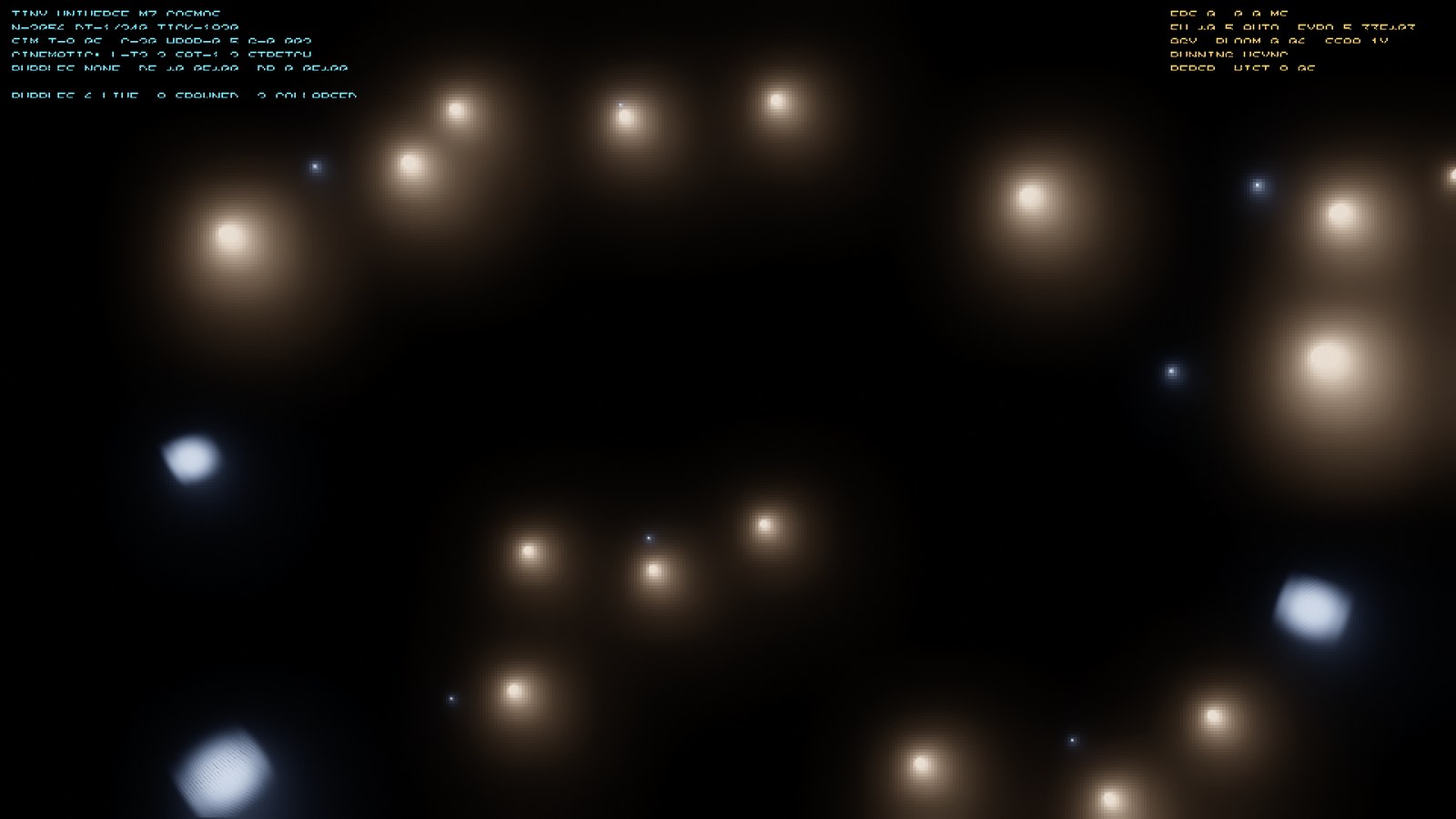
M1 · first light — a million stars, self-organized, at 499 fps.M2 · newton — the universe gravitates; structure condenses out of a particle-mesh field.M3 · arrow — violent relaxation; entropy rises, then reverses exactly on cue.M5 · gargantua — a black hole lenses its own Hawking glow into an Einstein ring.M6–M7 · roaming quanta — the blue ψ-glows are quantum bubbles; they collapse on contact with a record.M7 · cosmos — the wrapped 3-torus field, a black hole’s shadow bending the sky.
Measured, not asserted
Black holes form unscripted. No “spawn a black hole” switch exists: a 10⁶-particle cloud reaches a
density argmax, crosses the formation threshold on its own, and the entity appears — peak cell 182,720, its mass
growing past 1.5×10⁵. Evaporation is proven on a separate, seeded hole: an M=250 black hole that disappears
on the exact analytic Hawking clock (population tick 2991 vs expected 2991), energy ledger closed.
The measurement problem is a golden. Interference builds one particle at a time to a fringe contrast of
0.83; switch on a which-way detector and it dies to 0.052 — a 16× collapse, frozen as a reproducible hash.
The arrow of time is reversible microphysics. Entropy climbs through violent relaxation, and a
time-reversal returns it to the starting value to six decimals — the Loschmidt echo, byte-identical even through
the torus wrap.
When a claim fails measurement, it is withdrawn — and logged. A beautiful 7π precession claim was
retired at the measured 6.41π. The precise Choptuik critical exponent γ ≈ 0.374 is deferred, not faked — a
uniform grid caps the self-similar curvature, so the tool ships the transition it proves and names the exponent it
cannot yet reach.
The firewall
Tiny Universe renders mechanisms and proves structure — where a threshold sits, how an
entropy scales, whether a black hole forms — and takes no metaphysical position. It borrows the inscription
mathematics of THE UNFINISHED MIRROR (§6) for its Ratchet decoherence mechanic, but it never claims
that anything in it feels. Simulations prove structure, never acquaintance — the same firewall the theory
draws, honored here in code.
Build & verify it yourself
The toolchain is pinned: CUDA 13.1, -arch=sm_89 (RTX 40-series), MSVC 2022. No
fast-math in declared paths — an accelerated path ships with a paired-oracle error bound or it does not ship. The
CPU oracles need no GPU at all.
nvcc -O3 -arch=sm_89 -Xcompiler "/O2" -o build\tinyuniverse.exe app\tinyuniverse.cu core\lib\envelope.cpp ...
python harness\verify.py # every physics claim, cold — 22/22 green
The family
Tiny Universe is the gamified, playable sibling of a small governed-simulation family — same doctrine
(contract-first, deterministic, golden-gated), less dry:
THE UNFINISHED MIRROR — the theory this engine draws its Ratchet mechanic from; Tiny Universe
renders its mechanisms without taking its metaphysical stance.
ORRERY — the headless instrument the theory calls to put its claims to a measured
test. Tiny Universe lifts ORRERY’s deterministic core (liborrery) verbatim.
Quarries — buddhabrot-cuda (the
one-binary-two-faces, two-stream pattern) and astra-7
(the regime-composition nexus).
What’s next — v2 SUBSTRATE. A one-field rewrite where the quantum↔classical boundary becomes a
dial instead of a code path. Its hard problems — resolving the precise Choptuik exponent, BSSN stability at
toy dials — are being attacked with a novel adversarial AI-tournament methodology: diverse
approach-personas, cross-examined and armed with ORRERY so every claim is evidence-grade. That branch lands here as
it matures.